Buying preloved Y2K: what is genuine, what is revival, and what to check
Written by MegShare
Y2K is the thing people ask me about most. Some of what I list is genuinely from the early 2000s, some is a newer piece cut in that style, and both are worth having as long as you know which is which.
Telling an original from a revival
The care label is the giveaway. Older labels often carry a brand name that has since disappeared, sizing written differently, or a country of manufacture that a current-season piece would not have. Hardware is the other tell: genuine early-2000s pieces tend to have heavier metal zips, and branded rivets or plaques that a modern homage usually skips.
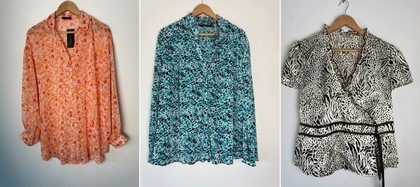
Print and cut help too. Butterfly and rose prints, low-rise waistbands that sit properly on the hip, bootcut and flared legs, halter and cami tops with thin adjustable straps. When something is a modern piece in the style, I say so in the listing rather than implying an age I cannot verify.
A few more things I look at when I am grading. Old side seams on jeans are often single-needle and slightly wobbly, where a lot of newer fast fashion is chain-stitched dead straight. Linings on early-2000s going-out tops are frequently a separate piece of acetate rather than the bonded jersey you see now. And original garment labels tend to be woven and sewn on all four sides, while newer ones are often printed straight onto a satin ribbon or heat-pressed inside the neck. None of these on their own prove an age, but three or four together usually tell me what I am holding.
Honestly, revival pieces are easier to live with in some ways. The stretch is intact, the seams have not been washed a hundred times, and the sizing is closer to what you expect. If you want the look without the guesswork, that is a sensible place to start, and a lot of what sits in New Look and River Island falls into that category.
What wears out first, and what to look at in the photos
On twenty-year-old denim, look at the inner thigh and back pocket corners: that is where thinning shows before it becomes a hole. Elastane loses its stretch with age, so waistbands on stretchy pieces can feel looser than the label suggests. On mesh and net layers, check for snags and small pulls, and on anything beaded or sequinned, expect the occasional missing piece and read the listing for whether I have found any.
Zips are the one repair most worth making. A replacement zip on a good pair of jeans is cheap and quick, and it should not put you off an otherwise sound piece.
Two other spots worth a proper look. Underarms on pale cami tops, because old deodorant marks sit in the fibre and do not always come out, and I will say in the listing if there is any shadowing. And the back neck on halters, where a single fine strap has been carrying the weight of the whole top for years. If that seam has started to pucker, it needs a few reinforcing stitches before you wear it out.
Elastic in a shirred back panel is the one thing I would think twice about. Once the rubber has gone brittle it snaps in the wash and there is no tidy fix. I photograph shirring stretched out so you can see whether it still recovers.
Sizing, honestly
Early-2000s sizing runs smaller than the same number today, sometimes by a full size, and low-rise fits differ wildly between brands. This is the single biggest reason people return vintage-era pieces, so ask me for the measurements before you buy. I measure the actual garment flat and send them back, usually the same day.
With low-rise in particular, ask for the front rise rather than the waist. Two pairs of jeans can share a waist measurement and sit four inches apart on your body, and the rise is what decides whether you will actually wear them. If you tell me the rise on a pair you already own and like, I can compare against it directly, which is faster than either of us guessing.
Condition and what I will and will not list
Most of what I sell is graded very good, which means it has been worn and washed and has nothing I would want to point at. Where something is older I use good or fair more often, and the listing spells out exactly what earned that grade. I do not list anything with a hole in a visible place, a broken zip I have not replaced, or staining I could not shift, unless it is a piece worth having anyway and the listing makes the fault plain in words and photos.
Washing and storing older pieces
Cold wash, inside out, in a mesh bag if there is any beading. Skip the tumble dryer entirely on anything with elastane, because heat is what finally kills old stretch. Hang cami tops and slip dresses on padded hangers or fold them flat, since thin straps stretch out under their own weight over a season. Satin and acetate crease hard, so a cool iron with a cloth over the top is safer than steam straight onto the fabric.
Building outfits around one Y2K piece
One era piece per outfit is usually plenty. A pair of bootcuts with a plain modern tee, or a butterfly-print cami under a normal jacket, reads better than a full head-to-toe reconstruction. If you are after the print rather than the silhouette, there is often crossover in animal print and in the going-out end of mini dresses.
Everything currently on the rail is in Y2K, and there is more in trousers and jeans and mini dresses. If you are hunting a specific brand from that era, brands A to Z is the fastest way to look.